
Introduction
The digital world is full of identifiers that are created for machines rather than humans. A website, application, database, or automated service can generate a combination of letters and numbers that looks confusing when viewed outside its original environment.
30.6df496–j261x5 is an example of such an unusual sequence. It does not immediately resemble a conventional word, familiar product name, or widely recognized technical term. Its unusual format naturally raises questions about what it represents and why it exists.
The challenge is that a digital reference cannot always be understood by looking at its characters alone. The website, software, database, file, or process that produced it may contain the information needed to explain its purpose.
This article takes a careful look at 30.6df496–j261x5, examining its structure, possible digital contexts, useful clues, verification methods, and common mistakes to avoid when researching an unfamiliar reference.
What We Know About the Reference
The first step in responsible research is separating observations from assumptions.
The visible sequence contains a mixture of numbers and letters:
30.6df496–j261x5
It also contains punctuation and a separator between different sections.
This makes the reference visually similar to many computer-generated strings.
However, its appearance does not prove that it belongs to a particular category.
It cannot automatically be described as a product code, software license, tracking number, security key, database ID, or any other specific type of reference without supporting evidence.
The most accurate starting point is simply to recognize it as an unusual alphanumeric digital reference whose meaning depends on its original context.
Why Does 30.6df496–j261x5 Look Different?
Several characteristics make the sequence unusual.
Mixed Characters
The reference combines numbers and letters rather than using ordinary words.
Multiple Sections
The period and dash-like separator visually divide the sequence into separate parts.
Limited Readability
Unlike a descriptive name, the characters do not clearly tell a human reader what the reference represents.
Technical Appearance
The combination resembles formats often used by computer systems to generate internal values.
These characteristics make 30.6df496–j261x5 interesting to investigate, but they should be treated as clues rather than proof.
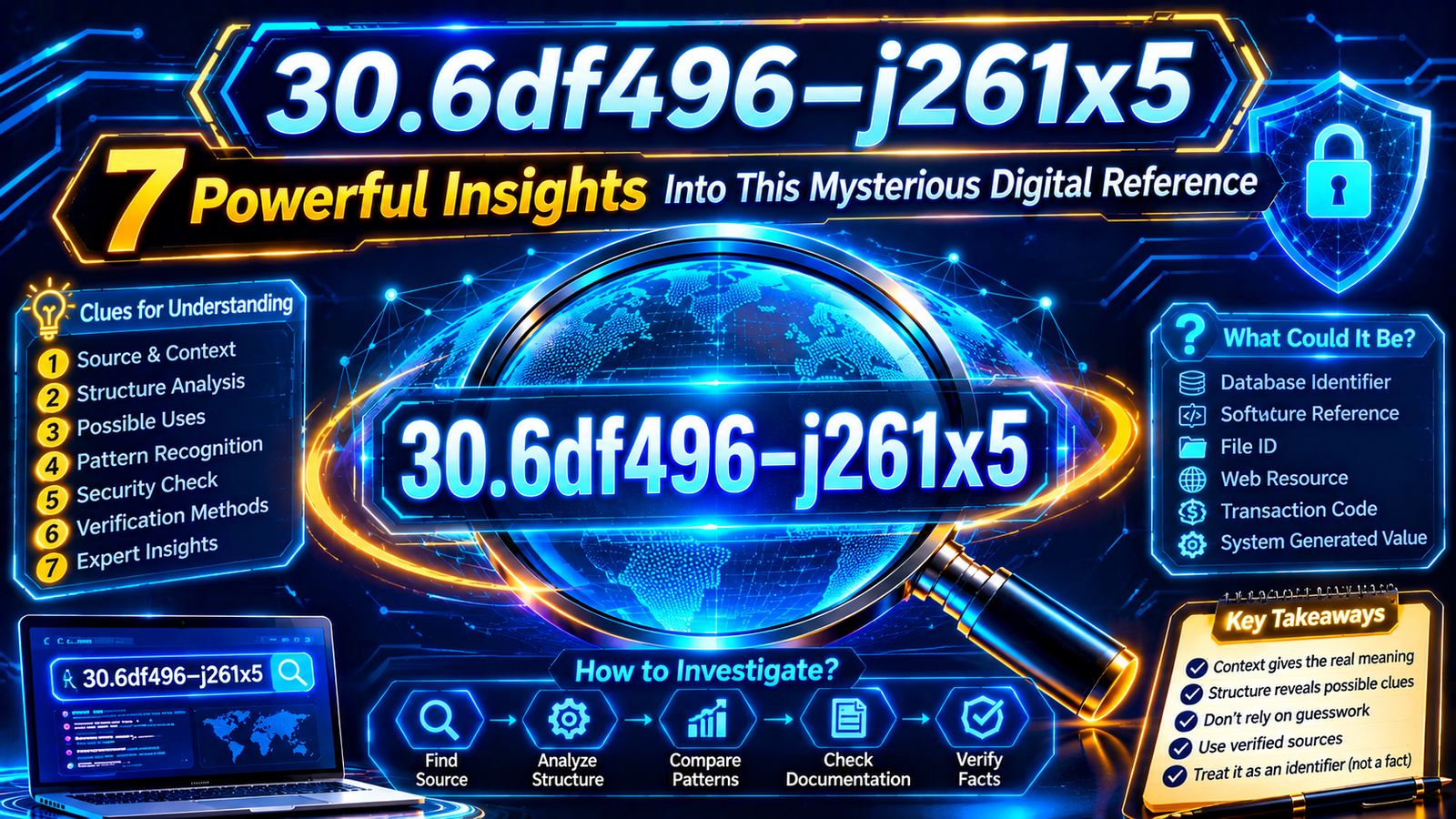
7 Powerful Insights for Understanding 30.6df496–j261x5
1. Context May Be More Valuable Than the Characters
The strongest clue may be the location where the reference appeared.
If you found 30.6df496–j261x5 on a website, examine the page.
If it appeared inside an application, identify the application.
If it was included in a document, investigate the document’s source.
If it appeared in a technical message, examine the surrounding message.
The environment can provide information that the reference itself does not reveal.
2. It May Have Been Generated Automatically
Many digital systems create identifiers automatically.
A system may need to distinguish one record from another without creating a long descriptive name for every item.
An automatically generated value can therefore look random while still serving a practical purpose.
This possibility makes the structure of 30.6df496–j261x5 compatible with a general class of computer-generated references.
It does not, however, identify the exact system responsible for creating it.
3. The Complete String May Matter More Than Individual Characters
People often try to decode unusual strings character by character.
For 30.6df496–j261x5, that approach may not be reliable.
The 30 could simply be part of the identifier.
The 6df496 section could be another generated component.
The j261x5 section could perform another role within the same system.
Without documentation, there is no dependable reason to assume that every section contains a readable hidden message.
The complete value may function as one identifier.
Read more: What Is 30.6df496–j261x5? A Complete Guide to This Unusual Identifier
4. Similar References Can Reveal a Pattern
Another useful clue is comparison.
Suppose you discover several strings that resemble 30.6df496–j261x5.
Look for similarities and differences.
Do they contain:
- The same number of characters?
- Similar separators?
- Similar letter combinations?
- Similar numerical sections?
- A consistent beginning or ending?
Patterns can sometimes reveal whether a system uses a particular identifier format.
This method is especially useful when investigating large collections of records.
5. Official Documentation Can Provide the Strongest Answer
If the reference belongs to a known software platform, website, or digital service, check its official documentation.
Technical documentation may explain:
- Identifier formats
- Reference numbers
- Database fields
- File naming systems
- Generated values
- Error references
- Resource IDs
A documented explanation is much stronger than a random online interpretation.
For 30.6df496–j261x5, official information should therefore be prioritized whenever it is available.
6. Repetition Can Be an Important Clue
Consider how often the same reference appears.
If 30.6df496–j261x5 appears only once, it could be a temporary or individual value.
If the exact same sequence appears repeatedly, it may be connected with one specific resource.
If many similar references appear in the same environment, they may belong to a larger identifier system.
Repetition does not automatically reveal the meaning, but it can help researchers understand how the value behaves.
7. Security Should Be Evaluated Separately
An unfamiliar string can look suspicious.
However, the appearance of 30.6df496–j261x5 alone does not prove that it is malicious.
A security assessment requires information about the surrounding environment.
For example, an ordinary identifier appearing inside normal software data is very different from an unfamiliar value appearing alongside a verified security warning.
The reference should therefore be investigated as technical information first rather than automatically being labeled dangerous.
Where Could an Unusual Reference Appear?
Understanding possible environments can help organize an investigation.
Websites
Websites may use internal identifiers for pages, resources, records, or other digital objects.
Applications
Desktop and mobile applications can create references for projects, files, sessions, requests, or objects.
Databases
Databases require identifiers to distinguish records.
Digital Files
Files and media resources may receive generated names or references during storage and processing.
Automated Systems
Background processes can create temporary values while performing different operations.
These are general possibilities. The actual meaning of 30.6df496–j261x5 still depends on the source where it was encountered.
A Practical Investigation Map
Instead of asking only “What does this code mean?”, use a series of smaller questions.
Question 1: Where Did It Appear?
Identify the exact website, application, document, or system.
Question 2: What Was Happening?
Think about what action occurred immediately before the reference appeared.
Question 3: What Was Around It?
Look at headings, labels, messages, buttons, fields, and nearby information.
Question 4: Are There Similar Values?
Search for other references with a comparable structure.
Question 5: Is There Official Documentation?
Check the relevant developer, platform, or service documentation.
Question 6: Is the Interpretation Supported?
Separate evidence from assumptions.
Question 7: Can the Result Be Independently Verified?
A reliable conclusion should ideally be supported by more than the appearance of the string.
What the Reference Is Not Automatically
An unusual format can encourage exaggerated interpretations.
It is important not to automatically classify 30.6df496–j261x5 as a:
- Virus
- Malware signature
- Password
- Product number
- License key
- Secret message
- Hacking tool
- Tracking code
- Transaction number
Any of these classifications would require evidence.
A responsible article should explain possibilities without presenting speculation as established fact.
Why Search Results Can Be Misleading
Searching an unusual string can produce confusing results.
A webpage may mention a similar sequence without explaining its origin.
Another page might assign a specific meaning without providing evidence.
A third source could simply repeat the same unsupported claim.
This is why search visibility does not automatically equal credibility.
When researching 30.6df496–j261x5, consider the quality of the source rather than simply counting how many pages mention it.
Better Evidence Usually Comes From
- Official documentation
- Developer information
- Original source material
- Technical references
- Reliable platform documentation
Weaker Evidence May Include
- Anonymous posts
- Unverified claims
- Pages without supporting information
- Repeated speculation
Understanding Identifiers in Modern Technology
Identifiers are fundamental to digital systems.
A platform may need to keep track of thousands of users, files, products, requests, records, or resources.
Using a unique or sufficiently distinct reference helps the system manage these objects.
Such references are often not designed to be memorable.
This explains why a value such as 30.6df496–j261x5 can look meaningless to a person while potentially being useful to a computer system.
The identifier does not necessarily need to describe the object.
It may simply distinguish that object from another one.
Could the Reference Be Related to a Database?
A database is one environment where unusual identifiers can make sense.
Imagine a table containing many records.
Each record might have an identifier that allows the system to retrieve or update the correct entry.
The identifier could be readable, numerical, or automatically generated.
If 30.6df496–j261x5 appeared in database-related information, useful clues would include the field name, table structure, related records, and software responsible for managing the database.
Without those details, the exact database role cannot be confirmed.
Could It Be Connected to a File?
Digital platforms often process documents, images, videos, and other resources.
During this process, a system may assign an internal reference.
The visible file name might be completely different from the internal identifier.
Therefore, if 30.6df496–j261x5 appeared near a file, do not immediately assume that it is the actual file name.
Investigate the application, storage system, and surrounding metadata instead.
Could It Be a Product or Inventory Reference?
Commercial systems can also use alphanumeric references.
Inventory platforms may assign values to products, stock entries, shipments, or catalog records.
However, the structure of 30.6df496–j261x5 alone is not sufficient to establish that it is a commercial product code.
A manufacturer, catalog listing, product description, or official business documentation would provide stronger evidence.
Read more: Financial Marketing in 2025: Navigating the Convergence of Tech, Trust & Personalization
The Importance of Preserving Original Information
When someone discovers an unfamiliar reference, they may copy only the strange sequence.
That can remove valuable clues.
Instead, preserve:
- The exact string
- The page or application
- Nearby text
- The date it appeared
- Related values
- The action that preceded it
- Relevant screenshots or records
This information can make later investigation significantly easier.
The context surrounding 30.6df496–j261x5 may ultimately be more informative than the reference itself.
A Simple Evidence Table
A structured table can help separate observation from interpretation.
| Evidence | What It Can Tell You |
|---|---|
| Exact string | Prevents transcription mistakes |
| Source location | Identifies the environment |
| Nearby label | May indicate the reference type |
| Similar values | Can reveal a pattern |
| Application name | Narrows possible meanings |
| Official documentation | Can confirm the function |
| Repeated occurrence | Shows how the reference is used |
This method makes digital research more systematic.
Common Research Mistakes
Guessing From the Number
The number 30 may look meaningful, but there is no reliable reason to assign it a special interpretation without context.
Treating Letters as an Abbreviation
The letters may be generated characters rather than an abbreviation.
Assuming It Is Dangerous
An unfamiliar string is not automatically a security threat.
Trusting the First Search Result
The first result is not necessarily the most authoritative source.
Ignoring the Original Context
Removing the surrounding information can make identification much harder.
Presenting Possibilities as Facts
A plausible explanation should remain a possibility until evidence confirms it.
A Reliable Way to Describe 30.6df496–j261x5
If you need a concise description, the safest wording is:
30.6df496–j261x5 is an unusual alphanumeric digital reference whose exact meaning depends on the system or context where it appears.
This description does not exaggerate what is known.
It also leaves room for further investigation.
As more information becomes available, the reference can potentially be classified more precisely.
What Additional Information Would Solve the Mystery?
If you want to investigate 30.6df496–j261x5 more deeply, several pieces of information would be especially useful.
Original Source
Where exactly was it found?
Surrounding Content
What words appeared immediately before and after it?
System Information
Which website, software, or platform displayed it?
Related References
Were there other values with a similar structure?
Documentation
Does the relevant system explain its identifiers?
Purpose
What were you doing when the reference appeared?
Together, these clues can provide a much stronger basis for identifying the reference.
Final Perspective
Unusual digital references can seem mysterious because they are often created for technical systems rather than human readers.
30.6df496–j261x5 has a mixed alphanumeric structure that resembles the general appearance of many automatically generated digital values. It could potentially occur in software, databases, websites, files, inventory systems, or automated processes.
However, its exact meaning cannot responsibly be determined from the characters alone.
The strongest approach is to investigate the context first. Identify the source, preserve surrounding information, compare similar references, and check reliable documentation.
Most importantly, separate confirmed information from plausible explanations and unsupported guesses.
A strange-looking identifier does not automatically represent something dangerous or mysterious. In many cases, it may simply be a technical reference that makes perfect sense to the system that created it.
Understanding 30.6df496–j261x5 therefore requires less guessing and more evidence. Once the original environment is known, the path toward a reliable explanation becomes much clearer.
Frequently Asked Questions
What is 30.6df496–j261x5?
30.6df496–j261x5 is an unusual combination of numbers, letters, and punctuation. Its exact function cannot be confirmed without knowing where it originated.
Is 30.6df496–j261x5 a technical identifier?
Its structure is consistent with the general appearance of technical or automatically generated identifiers, but its exact classification requires additional evidence.
Is 30.6df496–j261x5 a product code?
There is not enough information to confirm that it represents a product or inventory code.
Could 30.6df496–j261x5 be generated by software?
Yes, software systems commonly generate unusual references for files, records, objects, resources, or processes. The specific origin of this reference remains dependent on context.
Does 30.6df496–j261x5 have a universal meaning?
No universal meaning can be established from the sequence alone. Different systems can use completely different identifier formats.
Is 30.6df496–j261x5 dangerous?
The string itself does not establish that it is malicious or dangerous. Security concerns should be evaluated using the broader context.
How can I identify 30.6df496–j261x5?
Record the exact string, identify where it appeared, examine nearby information, compare similar references, and consult official documentation associated with the relevant system.
Conclusion
The mystery surrounding 30.6df496–j261x5 comes largely from its unfamiliar appearance.
Rather than forcing a single interpretation, it is more useful to treat the sequence as an unidentified digital reference and investigate the environment that produced it.
Its structure may resemble automatically generated values used by modern software and digital platforms, but structure alone cannot establish its exact purpose.
By following a context-first approach, preserving original information, comparing patterns, and verifying claims through reliable sources, researchers can avoid common mistakes and develop a more accurate understanding.
The central lesson is simple: the real meaning of an unusual digital reference usually comes from its context, not from the characters alone.
