
The cryptocurrency market is filled with technical explanations, project announcements, digital asset reviews, and investment opinions. For beginners, the challenge is not simply finding information but determining whether that information is reliable. A familiar brand name or professional website cannot independently prove that a particular cryptocurrency exists or offers the features described online.
Readers searching for ecryptobit.com tokens may want to understand educational content, investigate a possible digital asset, or learn how blockchain verification works. These are different research objectives and should be approached separately.
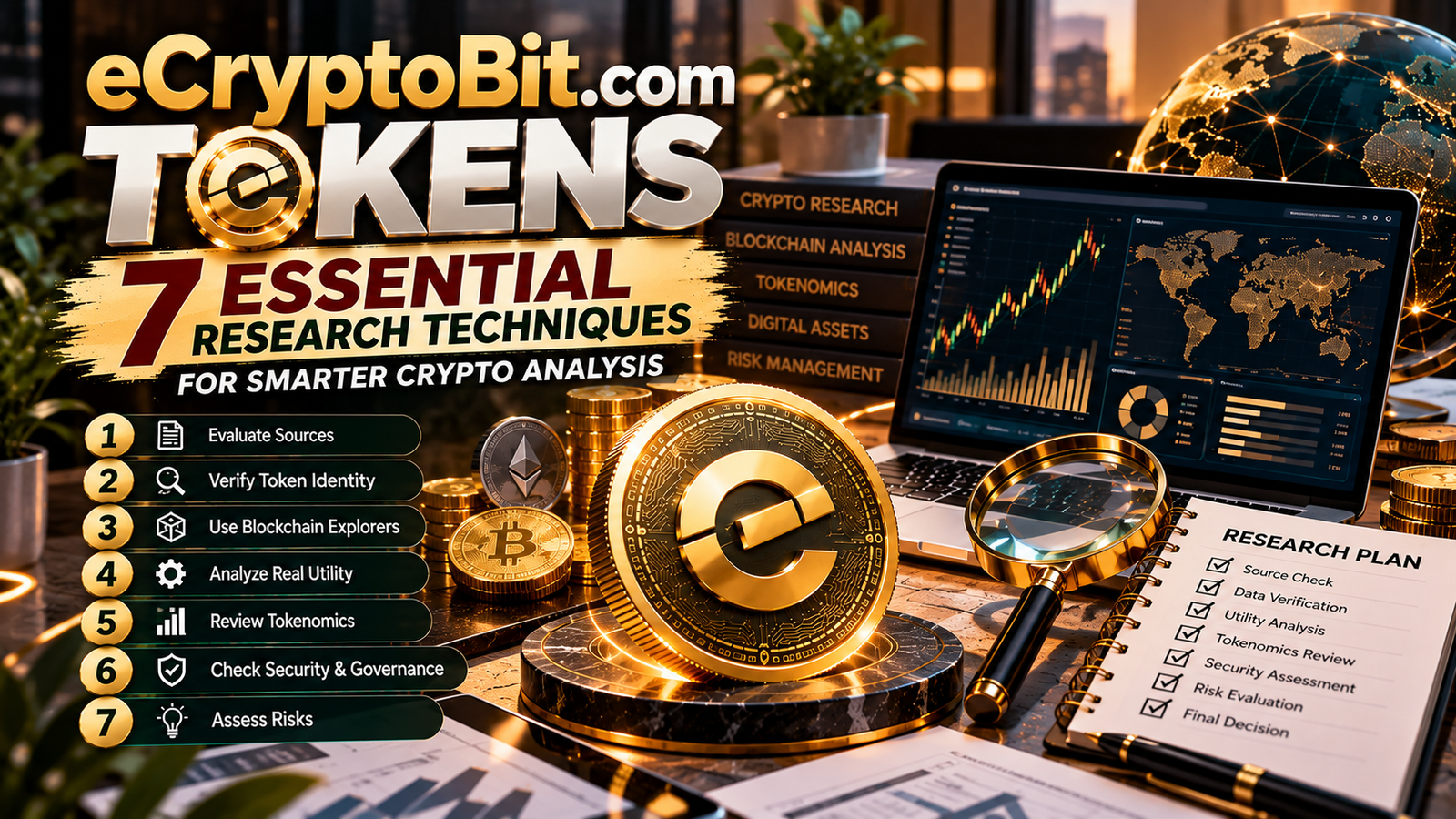
This article introduces seven practical research techniques covering source evaluation, technical verification, utility analysis, tokenomics, security, and risk management. The aim is to help readers distinguish documented facts from assumptions and make more informed decisions without relying on unsupported promises or speculative price predictions.
1. Develop a Source Evaluation System
Every research project begins with information gathering, but not every source deserves the same level of confidence. When examining ecryptobit.com tokens, begin by identifying who published the information and whether that source provides direct evidence.
Primary sources
Primary sources include official announcements, technical documentation, product terms, and other materials published by the organization responsible for a claim. These sources help establish what the organization actually says.
Start by visiting the official eCryptoBit website and reviewing its published content. Educational material about blockchain does not automatically establish that a website issues its own cryptocurrency.
Secondary sources
Independent reporting, reviews, and community discussions can provide context. However, check whether they cite original evidence or simply repeat statements from another article.
When researching ecryptobit.com tokens, record the source, publication date, and exact claim. If the original documentation cannot be located, label the statement unverified rather than assuming it is accurate.
2. Create a Digital Asset Identity Profile
Before assessing a cryptocurrency’s usefulness, establish what the asset is supposed to be. A token name or ticker symbol alone is not sufficient because unrelated assets can use similar names.
Information worth recording
A basic identity profile can include:
- The official name and stated purpose.
- The organization or individual identified as the issuer.
- The blockchain network, if applicable.
- The complete contract address, when one exists.
- The official documentation and publication date.
- Any independent evidence supporting the claimed identity.
This profile helps researchers organize information about ecryptobit.com tokens without mixing verified details with assumptions.
Why identity matters
A contract address can help identify a particular blockchain asset, but it does not prove that the asset is officially connected to a website. That relationship requires supporting documentation.
If the available information does not identify a specific asset, say so clearly. Avoid inventing an address, issuer, token supply, or exchange listing simply to complete a profile.
3. Use Blockchain Explorers Correctly
Blockchain explorers provide access to information recorded on supported networks. Depending on the blockchain, they may display transactions, contract interactions, token holders, and source-code verification details.
For ecryptobit.com tokens, the first step is to identify the claimed network and locate the correct explorer. Do not rely on a screenshot or a similar-looking token name.
Understand what the records show
A blockchain explorer may demonstrate that transactions occurred or that a contract has been deployed. However, recorded activity does not automatically prove genuine customer demand, trustworthy management, or future financial performance.
Wallet addresses may also represent exchanges, custodians, smart contracts, or related accounts. Transaction patterns need context before conclusions are drawn.
Read more: Attie AI Website Builder: 7 Powerful Features to Explore
Learn the technical fundamentals
The Ethereum developer documentation provides background on transactions, smart contracts, and blockchain infrastructure. The ERC-20 specification explains a widely used standard for fungible tokens on Ethereum.
These resources explain general technology. They do not independently confirm the existence or legitimacy of a particular branded asset.
4. Evaluate Utility Through Observable Features
A token’s purpose should be clear enough to explain without relying on marketing slogans. When investigating ecryptobit.com tokens, assess each claimed feature individually.
Access to products or services
Some tokens provide access to digital services or platform features. Check whether the product exists, whether the token is required, and whether the documentation explains fees and restrictions.
Payments and transfers
A token may be designed to facilitate payments. Its practical usefulness depends on acceptance, transaction costs, network performance, and the availability of alternatives.
Governance and participation
Governance tokens may provide voting rights. The actual influence of holders depends on the voting rules, distribution of voting power, and how decisions are implemented.
Rewards and staking
Some projects offer rewards for staking or participation. These arrangements can involve lock-up periods, variable returns, smart-contract vulnerabilities, and financial losses.
These are general cryptocurrency use cases, not confirmed features of ecryptobit.com tokens. Claims about particular functions should be supported by current documentation and observable evidence.
5. Analyze Tokenomics Without Speculation
Tokenomics describes a digital asset’s supply, distribution, issuance rules, and incentives. It can help explain how a token is structured, but it cannot guarantee a future price.
Supply and circulation
Total supply and circulating supply may differ. Some assets reserve units for future release, while others permit additional issuance under defined rules.
When evaluating ecryptobit.com tokens, do not publish specific supply figures unless reliable documentation supports them. Record the source and date of any numbers used.
Distribution and concentration
If a small number of wallets hold a large portion of an asset, their transactions may influence liquidity or market sentiment. However, concentration alone does not prove wrongdoing because some addresses belong to exchanges, custodians, or project treasuries.
Vesting and future releases
Token unlock schedules can change the amount available in a market. Researchers should check documented schedules and understand their conditions rather than repeating unsupported dates or percentages.
If reliable tokenomics information is unavailable, leave the relevant details unconfirmed.
6. Investigate Security and Governance
Security analysis requires more than a polished website or a statement that a project uses blockchain technology. Researchers should examine technical reviews, contract permissions, and decision-making arrangements.
Read audit reports carefully
An audit examines a defined scope and version. Review the date, findings, and limitations. An audit of one smart contract may not cover the website, wallet integrations, administrative keys, or later code changes.
An audit can provide useful evidence but cannot guarantee that a project is honest or financially viable.
Understand privileged permissions
Some smart contracts allow authorized accounts to pause activity, change parameters, or manage issuance. These permissions may have legitimate purposes, but users should understand who controls them and how changes are governed.
Check transparency
Look for documentation explaining who approves upgrades, how disputes are handled, and whether users can participate in governance. A project’s actual rules matter more than its marketing labels.
For ecryptobit.com tokens, security claims should be assessed against evidence about the specific asset or contract rather than general statements about cryptocurrency security.
7. Build a Practical Risk Assessment
Cryptocurrency assets can be volatile, illiquid, technically complex, and vulnerable to fraud. A careful research process considers these risks before any financial decision.
Financial risks
A displayed price does not guarantee that an asset can be sold at that price. Low liquidity, fees, withdrawal restrictions, and platform problems can affect the ability to exit a position.
Fraud and impersonation
Be cautious of guaranteed returns, urgent investment requests, fake endorsements, and claims that losses are impossible. Popularity and positive comments do not prove that an offer is legitimate.
Personal security
Never share a private key or wallet recovery phrase with someone claiming to provide support. Check website addresses carefully, avoid suspicious links, and inspect transaction details before signing.
These precautions are important when researching ecryptobit.com tokens or any unfamiliar digital asset.
For additional guidance, consult the Federal Trade Commission’s cryptocurrency scam resources.
A Research Worksheet for Better Decisions
Before accepting a digital asset claim, create a short record containing the following details:
- Claim: What exactly is being stated?
- Source: Who published the information?
- Evidence: What documentation supports it?
- Technical identity: Is the network or contract address verified?
- Utility: Can the claimed feature be demonstrated?
- Risks: What financial or security concerns remain?
- Unknowns: Which important details have not been established?
This worksheet turns cryptocurrency research into a repeatable process. If important information about ecryptobit.com tokens remains unavailable, the responsible conclusion is that the relevant claim has not been verified.
Read more: The Ultimate Guide to Choosing the Perfect Chandelier
Frequently Asked Questions
What does ecryptobit.com tokens mean?
The phrase may refer to cryptocurrency educational content on the eCryptoBit website or to claims about a digital asset associated with that name. Its intended meaning should be established through official information.
Does eCryptoBit have a verified native token?
The information considered for this article does not clearly establish a native token with independently verified contract details and published tokenomics. Current official documentation should be checked before making a definitive statement.
How can I verify a token’s identity?
Identify the blockchain network, obtain the complete contract address from a reliable source, and compare it with the appropriate explorer. Similar names and symbols are not sufficient proof.
Does a security audit guarantee safety?
No. An audit has a defined scope and date and may not cover every component or later change. It cannot eliminate all technical, financial, governance, or fraud risks.
Are staking rewards guaranteed?
No. Rewards may change and may involve lock-up periods, technical vulnerabilities, or financial losses. Review the terms carefully before participating.
What should beginners do if evidence is missing?
Do not treat missing information as proof that a claim is true. Compare credible sources, wait for verifiable documentation, and avoid risking money needed for essential expenses.
Conclusion: Make Evidence the Foundation of Research
Reliable cryptocurrency analysis begins with a clear question and follows a structured process. Researchers should trace claims to their sources, verify technical identifiers, test utility against real features, examine tokenomics, and understand security and liquidity risks.
The phrase ecryptobit.com tokens should not be treated as proof that a particular native asset exists or has a specific market value. Establish what the phrase refers to, verify the available evidence, and keep unsupported assumptions out of the final assessment.
Careful research is more valuable than confident predictions. Verify first, protect your accounts, and make decisions only after understanding the available evidence and the risks involved.
