
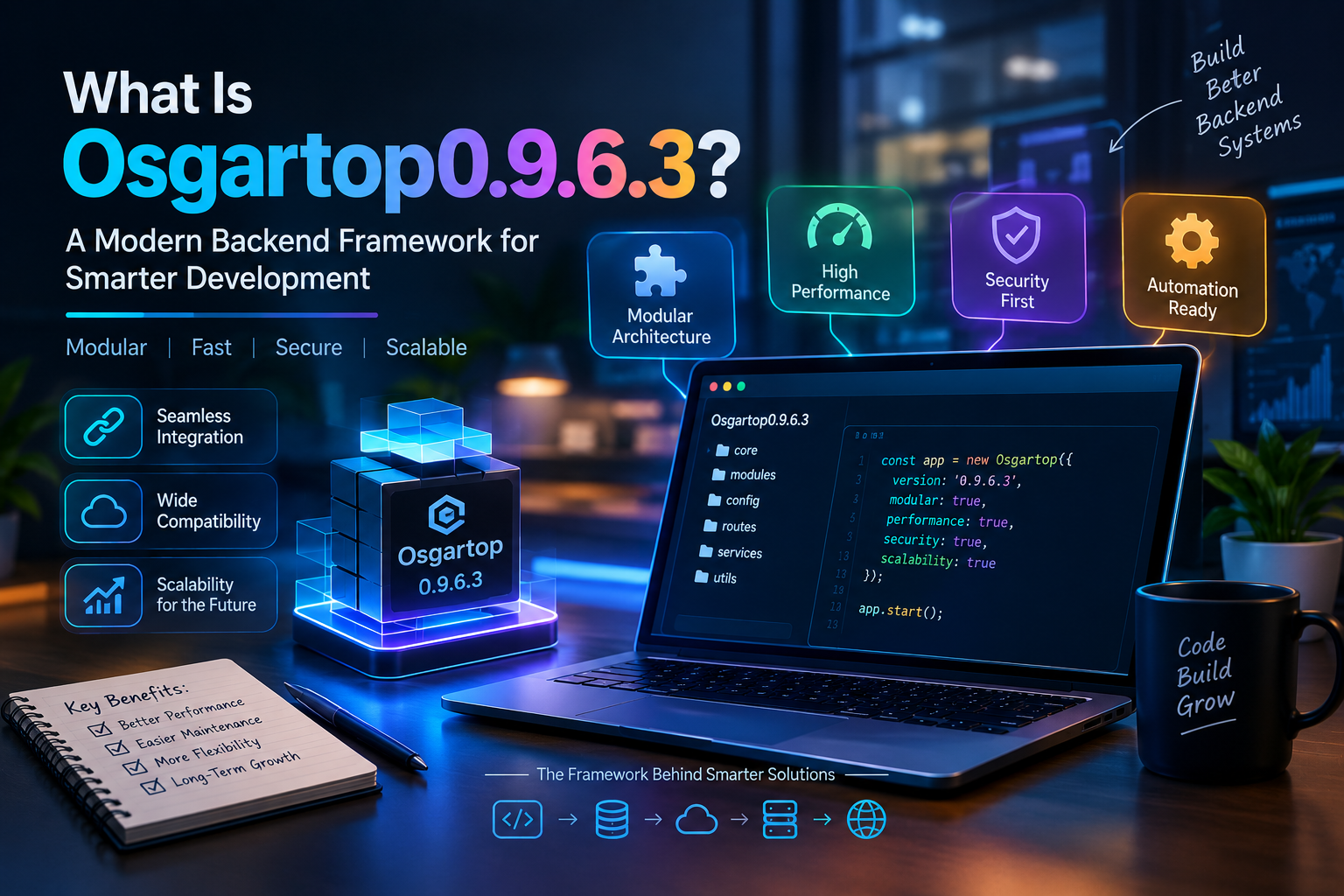
Software development is filled with frameworks, version numbers, utilities, and technical identifiers. Some are instantly recognizable, while others look unfamiliar even to experienced users. The phrase what is osgartop0.9.6.3 has attracted attention because it combines an unusual project name with a detailed version identifier.
The source describes Osgartop0.9.6.3 as a lightweight, modular backend framework focused on performance, scalability, automation, integration, and reliable server-side operations. Its version structure is presented as an evolving release, with the initial zero suggesting a development-stage version and the higher minor and patch numbers indicating continued refinement.
This guide takes a fresh approach to what is osgartop0.9.6.3, looking at the framework through seven practical areas: architecture, resource management, performance, reliability, compatibility, security, and future growth.
A Quick Starting Point
Before asking what is osgartop0.9.6.3, it helps to understand what a backend framework actually does.
A backend framework provides structures and tools for server-side application development. It can help organize APIs, application logic, data processing, authentication, automation, logging, and communication between different services.
The source presents Osgartop0.9.6.3 as a system built around simplicity and efficiency. Its modular architecture is intended to let developers select the components they need instead of carrying unnecessary functionality.
The Main Concept
The central idea behind what is osgartop0.9.6.3 is not simply adding more features. It is about creating a backend environment where developers can build and operate applications while paying attention to performance, resource usage, flexibility, and maintainability.
That makes the framework interesting for anyone learning how modern backend systems are organized.
7 Powerful Insights Behind Osgartop0.9.6.3
1. The Version Number Provides an Important Clue
One of the first things to examine when researching what is osgartop0.9.6.3 is the version structure itself.
The source explains that the initial zero indicates a development-stage release rather than a completely mature major release. At the same time, the minor and patch numbers indicate continued development and refinement.
Why Versioning Matters
Version numbers help developers understand the stage of a software project. They also provide a method for tracking updates, managing compatibility, and planning upgrades.
For a backend framework, version management can be particularly important because changes may affect APIs, dependencies, configurations, security behavior, and deployment processes.
The version information therefore becomes a useful starting clue when exploring what is osgartop0.9.6.3.
2. Modular Architecture Is a Major Feature
Another important part of what is osgartop0.9.6.3 is its modular architecture.
According to the source, developers can select the components they actually need. This approach can reduce unnecessary overhead and make the overall system easier to customize.
Benefits of a Modular System
A modular design can offer several practical advantages:
- Easier maintenance
- Flexible configuration
- More targeted deployments
- Simpler component updates
- Better separation of responsibilities
- Potentially lower unnecessary overhead
If a particular component needs to be changed, developers may be able to work on that component without rebuilding the entire backend system.
Read more: 30.6df496–j261x5: 7 Powerful Insights Into an Unusual Digital Reference
Why Modularity Matters
Large applications can become difficult to maintain when every function is tightly connected.
Modular architecture attempts to reduce this complexity by separating different responsibilities into manageable sections.
For developers researching what is osgartop0.9.6.3, this architectural approach is one of the most important concepts to understand.
3. Lightweight Resource Management
Another major aspect of what is osgartop0.9.6.3 is its emphasis on lightweight execution.
The source presents the framework as designed to minimize unnecessary resource usage. This can be useful when applications operate under restrictions involving memory, processing power, infrastructure capacity, or operational costs.
Why Resource Efficiency Matters
Modern applications may run in cloud environments, containers, virtual machines, or edge-computing systems.
Each environment can have different resource requirements.
A lightweight design may help developers create systems that do not depend on excessive processing or memory consumption.
Cloud and Edge Computing
Cloud services can scale according to demand, while edge devices may have considerably fewer resources than traditional servers.
For this reason, the resource-management philosophy described in what is osgartop0.9.6.3 can be relevant to different types of deployment environments.
However, lightweight design does not automatically guarantee faster performance. Real results depend on the application, workload, hardware, configuration, and implementation.
4. Performance Optimization Is Central
When researching what is osgartop0.9.6.3, performance is another important theme.
The source describes optimization strategies involving execution pipelines, memory allocation, and data-processing latency. These approaches are intended to help systems remain responsive under different workloads.
Handling Changing Workloads
Backend applications may experience normal traffic one moment and significantly higher demand later.
A well-designed system needs to handle these changes without unnecessary instability.
The source connects Osgartop0.9.6.3 with environments such as enterprise systems and real-time data-processing platforms.
Measure Instead of Assuming
When evaluating what is osgartop0.9.6.3, developers should not rely only on general performance claims.
Actual performance should be tested.
Useful measurements can include:
- Response time
- CPU utilization
- Memory consumption
- Throughput
- Error rates
- Peak-load behavior
- Resource usage
Testing with realistic workloads provides a better understanding of whether a framework is appropriate for a particular project.
5. Stability, Monitoring, and Diagnostics
A backend framework can be fast but still difficult to manage if troubleshooting is complicated. This is another important area connected with what is osgartop0.9.6.3.
The source highlights error handling, logging, monitoring, and diagnostic capabilities as part of its approach to stability and reliability.
Why Logging Is Important
Logs help developers understand what happened inside an application.
A good logging system can help identify:
- Failed requests
- Configuration problems
- Unexpected behavior
- Performance issues
- Integration failures
- System errors
Monitoring Adds Another Layer
Logging records events, while monitoring helps teams observe system behavior over time.
Together, these capabilities can make troubleshooting more systematic.
For people researching what is osgartop0.9.6.3, monitoring and diagnostics are important because performance alone does not determine whether a backend system is practical.
6. Compatibility and Integration
Modern backend applications rarely operate independently. They often communicate with databases, APIs, authentication systems, cloud infrastructure, monitoring services, and other software.
This makes compatibility an important part of what is osgartop0.9.6.3.
The source describes the framework as designed to integrate with different operating systems, hardware configurations, and third-party tools.
Why Integration Can Become Difficult
Different systems may use different:
- Data formats
- Authentication methods
- Dependencies
- Protocols
- Configuration requirements
- Version standards
A framework that simplifies integration can potentially reduce the amount of custom code developers have to maintain.
Test Before Production
Even when a framework is designed for compatibility, developers should test it in their actual environment.
A practical testing process can include:
- Creating a controlled environment
- Installing required dependencies
- Connecting external services
- Testing representative workloads
- Reviewing errors and logs
- Checking recovery procedures
This helps identify compatibility problems before production deployment.
7. Security and Responsible Development
Security is another major topic when considering what is osgartop0.9.6.3.
The source mentions authentication protocols, access controls, and data-integrity mechanisms as part of the framework’s security focus.
Authentication and Authorization
Authentication determines who can access a system.
Authorization determines what an authenticated user is allowed to do.
Both are essential for modern backend applications.
A secure implementation should also consider:
- Strong credential management
- Least-privilege permissions
- Secure configuration
- Dependency updates
- Input validation
- Monitoring
- Access reviews
A Framework Cannot Do Everything
Security is not achieved simply by selecting a particular framework.
Developers still need to configure applications correctly, protect secrets, manage permissions, monitor systems, and respond to vulnerabilities.
This is an important consideration when evaluating what is osgartop0.9.6.3 for real-world projects.
Where Can Osgartop0.9.6.3 Be Useful?
The source identifies several areas where Osgartop0.9.6.3 may be useful, including software development, enterprise systems, workflow management, and educational environments.
API Development
Backend frameworks commonly provide structures for building APIs.
These APIs allow different applications and services to exchange information.
A modular architecture can help organize routes, authentication, business logic, and supporting components.
Enterprise Applications
Businesses often operate applications involving large numbers of users, processes, and integrations.
Performance, monitoring, reliability, and scalability can therefore become important requirements.
Workflow Automation
Automation can reduce repetitive manual work.
The source describes workflow automation and process management as part of the framework’s capabilities.
Learning and Education
Backend frameworks can also provide useful learning environments.
Students can use practical projects to explore concepts such as:
- APIs
- Backend architecture
- Automation
- Logging
- Authentication
- Scalability
- System monitoring
For learners trying to understand what is osgartop0.9.6.3, these concepts provide useful background.
A Practical Implementation Roadmap
For anyone exploring what is osgartop0.9.6.3, implementation should be treated as a gradual process rather than something that should immediately be introduced into a critical production environment.
Phase One: Study the Documentation
Start by reviewing available documentation.
Understand:
- System requirements
- Dependencies
- Configuration
- Supported environments
- Installation procedures
- Known limitations
Phase Two: Create a Test Environment
The safest approach to what is osgartop0.9.6.3 is to experiment in an isolated environment.
A test environment allows developers to evaluate behavior without putting important production services at unnecessary risk.
Read more: Marketplace Ideas: Innovative Business Models for the Digital Economy
Phase Three: Build a Small Prototype
Instead of starting with a large application, create a small test project.
A basic API or automated workflow can reveal how the framework behaves.
Phase Four: Test Integrations
Connect the framework with the databases, APIs, authentication systems, and infrastructure that the real project requires.
This can expose compatibility issues early.
Phase Five: Evaluate the Results
After testing what is osgartop0.9.6.3 in a realistic environment, evaluate:
- Performance
- Stability
- Security
- Maintainability
- Compatibility
- Resource consumption
- Developer experience
Only then should a team decide whether the framework is appropriate for broader deployment.
Common Challenges Developers Should Expect
The source also identifies several potential challenges, including configuration errors, compatibility conflicts, and performance bottlenecks.
Configuration Problems
Incorrect configuration can cause applications to behave unexpectedly.
Careful testing and configuration reviews can help reduce these problems.
Compatibility Conflicts
Dependencies and external systems may not always work exactly as expected.
Testing each integration separately can make troubleshooting easier.
Performance Bottlenecks
Even an efficiency-focused framework cannot compensate for poorly optimized application code.
Developers should profile workloads and identify the actual source of slowdowns.
Ongoing Maintenance
An evolving framework requires regular attention.
Teams should monitor updates, review changes, and test upgrades before applying them to important systems.
Modular vs. Monolithic Architecture
One useful way to understand what is osgartop0.9.6.3 is to compare its modular philosophy with a more traditional monolithic approach.
| Area | Modular Approach | Traditional Monolithic Approach |
|---|---|---|
| Components | More separated | More tightly connected |
| Updates | Can target individual parts | May affect larger sections |
| Customization | Generally flexible | More centralized |
| Maintenance | Can be managed by component | Can become complex as systems grow |
| Resource use | Can be optimized by selection | May include broader functionality |
Neither approach is automatically better for every application.
The correct architecture depends on project requirements, infrastructure, team expertise, maintenance expectations, and application complexity.
Why This Version Is Interesting
The combination of a development-stage version and a strong focus on refinement makes Osgartop0.9.6.3 an interesting example of backend framework evolution.
The source presents several goals together:
- Efficiency
- Modularity
- Scalability
- Automation
- Security
- Reliability
- Integration
These priorities reflect many of the challenges faced by modern software teams.
For readers asking what is osgartop0.9.6.3, the bigger lesson is that backend frameworks are increasingly expected to balance performance with flexibility and operational simplicity.
Future Development Possibilities
Technology changes quickly, and backend frameworks must adapt to new infrastructure and development practices.
The source suggests potential future directions such as stronger automation, improved distributed-system integration, and advanced security capabilities.
Future development could also focus on:
- Better monitoring
- Improved deployment tools
- Developer experience
- Broader integrations
- Stronger security
- Distributed computing
These should be treated as potential directions rather than guaranteed features unless officially documented.
Frequently Asked Questions
what is osgartop0.9.6.3?
The phrase what is osgartop0.9.6.3 refers to a backend framework and version identifier described as a lightweight, modular system for backend operations, automation, integration, and performance optimization.
Is Osgartop0.9.6.3 a backend framework?
Yes. The source presents Osgartop0.9.6.3 as a lightweight and modular backend framework designed for server-side development and system operations.
Is Osgartop0.9.6.3 fully mature?
According to the source’s interpretation, the leading zero suggests that the framework remains in a development or pre-release stage, while its minor and patch numbers indicate continued refinement.
How does Osgartop0.9.6.3 handle performance?
The source describes optimization involving execution pipelines, memory allocation, resource usage, and data-processing latency.
Does Osgartop0.9.6.3 support automation?
Yes. Workflow automation, task management, and process efficiency are presented as important capabilities.
Can Osgartop0.9.6.3 integrate with other systems?
The source describes compatibility with multiple operating systems, hardware environments, and third-party tools. Actual compatibility should still be tested for each specific project.
Does Osgartop0.9.6.3 include security features?
The source mentions authentication, access controls, and data-integrity measures. Developers still need to configure and maintain security correctly.
What problems can occur with Osgartop0.9.6.3?
Potential challenges include configuration errors, compatibility issues, performance bottlenecks, and ongoing maintenance requirements.
Final Verdict
So, what is osgartop0.9.6.3? Based on the provided source, it is presented as a modern lightweight backend framework version built around modular architecture, performance optimization, resource efficiency, automation, compatibility, security, and scalability.
Its most interesting characteristic is the attempt to balance flexibility with low overhead. Rather than treating backend development as one large block of functionality, the framework is described as a modular environment where developers can select and manage components according to project requirements.
For teams considering such a framework, the best approach is practical testing. Documentation should be reviewed first, followed by a controlled prototype, integration testing, security checks, and performance measurement.
Ultimately, the value of any backend framework depends on how well it fits the application, infrastructure, development team, and operational requirements. what is osgartop0.9.6.3 is therefore best understood not simply as a version number, but as an example of a backend design philosophy centered on efficiency, modularity, and long-term scalability.
