
Introduction
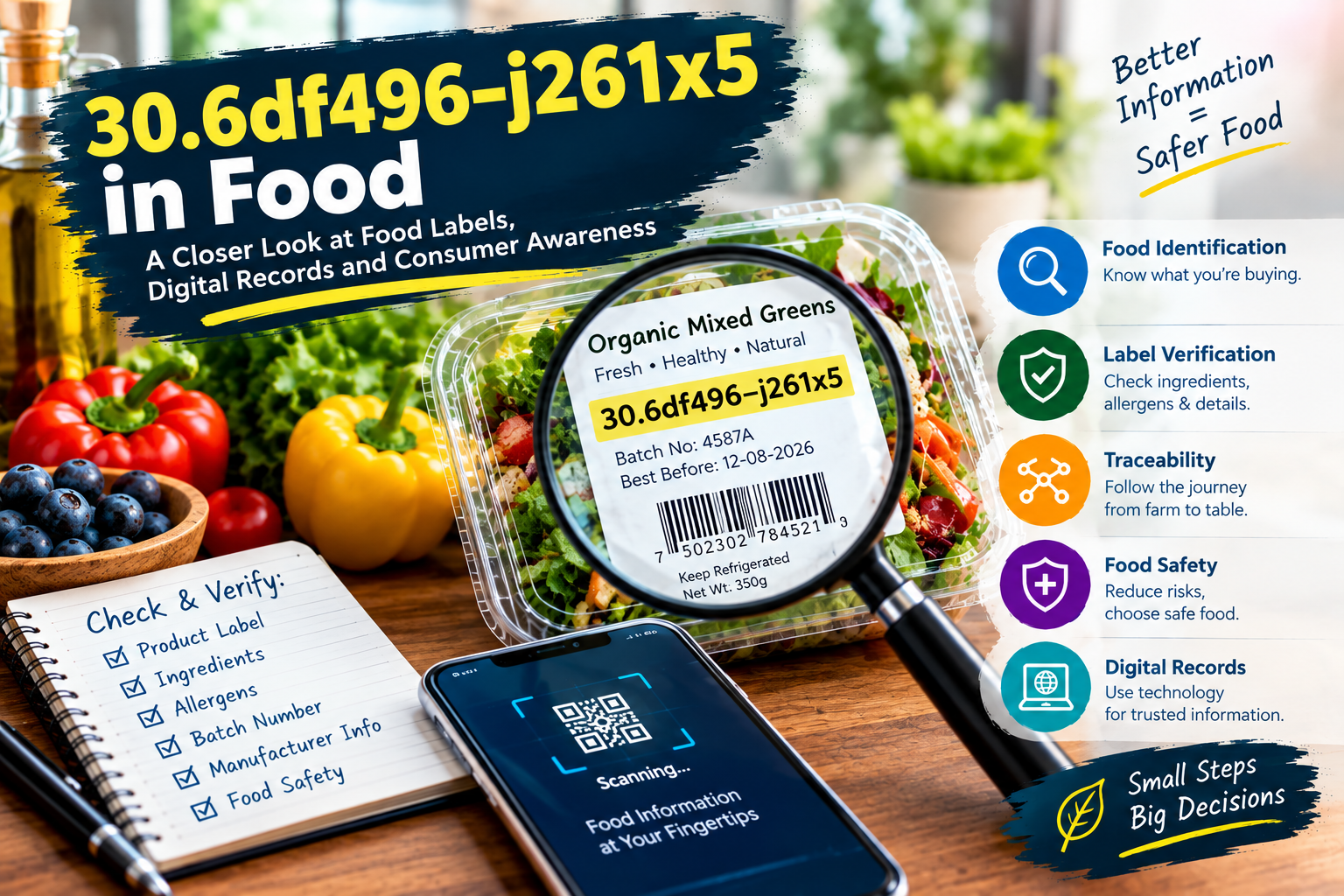
Food information has become an important part of modern shopping, product management, and consumer education. People regularly examine ingredient lists, nutritional values, manufacturing details, and digital records before deciding which products to purchase. However, unfamiliar combinations of letters, numbers, and symbols can create confusion when their meanings are not clearly explained. Understanding 30.6df496–j261x5 in Food provides an opportunity to explore how consumers can investigate unusual identifiers responsibly.
When researching 30.6df496–j261x5 in Food, the most important principle is to distinguish verified information from assumptions. An unfamiliar sequence does not automatically represent an ingredient, chemical additive, certification, or safety warning. Its meaning must be established through credible documentation or confirmation from the organization responsible for it.
This guide explores practical research methods, food-label interpretation, product traceability, digital information, and consumer awareness. It focuses on helping readers find reliable answers instead of accepting unsupported explanations.
1. Understanding the Purpose of Food Information
Food information helps consumers understand what they are purchasing and allows businesses to organize products throughout their supply chains. Packaging can include product names, ingredient declarations, manufacturing references, and other details that support identification and communication.
The first step in investigating 30.6df496–j261x5 in Food is to identify the context in which the sequence appears. A reference printed on packaging may require a different investigation from one mentioned in an online article or technical database. Recording the original source helps narrow the search and prevents unrelated information from influencing the conclusion.
Consumers should also identify the question they want answered. They may need to know whether a sequence identifies a product, refers to an internal record, or has a documented technical meaning. Clearly defining the question makes research more efficient and easier to verify.
2. Examine the Original Source
The original source often provides more useful information than a collection of copied explanations. A manufacturer’s document, product label, or official record may explain terminology that secondary websites discuss without sufficient detail.
When examining 30.6df496–j261x5 in Food, record the exact spelling, punctuation, and capitalization. Note the website address, document title, publication date, and surrounding text. These details can help establish whether the sequence belongs to the particular product or subject being investigated.
Avoid assigning meaning based only on how a code looks. Letters and numbers can appear technical without representing a recognized food standard. If the original source does not explain the sequence, look for relevant documentation or contact the organization that published it.
3. Read Food Labels as a Complete System
Food labels communicate several types of information. Depending on the product and applicable local requirements, packaging may display ingredients, allergen information, nutritional values, quantity, manufacturer details, storage instructions, and date markings.
If 30.6df496–j261x5 in Food appears on a package, examine the entire label rather than focusing exclusively on the unfamiliar sequence. Check whether it appears near a batch reference, product description, barcode, or another heading. Its location may provide context, but it does not independently prove the identifier’s purpose.
Taking a clear photograph of the front and back of a package can make further research easier. Include nearby text and relevant product details. If the label is unclear or essential information is missing, ask the manufacturer or retailer for clarification instead of relying on an unsupported online interpretation.
4. Distinguish Identifiers From Ingredients
Not every code associated with a food product identifies something contained in the product. Businesses may use references for inventory, production scheduling, shipping, or internal record management. Ingredients, meanwhile, should be understood through the appropriate product declaration and supporting documentation.
Research into 30.6df496–j261x5 in Food should therefore begin without assuming that the sequence names a particular ingredient or additive. An identifier can only be classified confidently when a relevant source explains its function.
Compare the sequence with the surrounding headings and terminology. If a technical document contains a glossary or identifier list, review that information before reaching a conclusion. Where no explanation exists, describe the sequence as unidentified rather than inventing a definition.
Read more: Cryptopronetwork com adrian: 10 Smart Questions for Better Crypto Content Analysis
5. Investigate Product Traceability
Traceability allows businesses to follow products through relevant stages of production and distribution. Records may help connect suppliers, processing facilities, manufacturing batches, warehouses, and retailers. These systems can support investigations when a quality issue requires further examination.
The possible relationship between 30.6df496–j261x5 in Food and traceability should be investigated through direct evidence. The sequence’s appearance alone cannot establish that it belongs to a tracking system or identifies a specific production batch.
If a manufacturer confirms that a code is connected to a traceability record, ask what the record covers and whether it applies to the product in question. Different businesses can use different identification formats, so one company’s system should not be treated as a universal standard.
6. Evaluate Online Information Carefully
Search engines make it easier to find articles, product pages, and technical documents. However, search results can include outdated content, unrelated matches, incomplete descriptions, and claims copied from other websites.
Anyone researching 30.6df496–j261x5 in Food should open relevant pages and examine the actual evidence. Check the publisher’s identity, publication date, references, and links to original documentation. A short search-result description is not sufficient proof of a code’s meaning.
Compare important claims against sources that have direct knowledge of the product or identifier. If several websites repeat the same explanation without independent evidence, repetition does not establish accuracy. Reliable research depends on the relevance and quality of the supporting material.
7. Understand Food Safety Information
Food safety information helps consumers understand appropriate handling, storage, labeling, and recall instructions. However, a safety conclusion should be based on relevant evidence rather than speculation about an unfamiliar identifier.
The presence of 30.6df496–j261x5 in Food does not establish that a product is dangerous, contaminated, approved, or completely safe. These conclusions require different forms of evidence and should not be inferred from an unexplained sequence.
For genuine concerns, review the complete packaging and consult the responsible manufacturer or relevant food-safety authority. If an official recall applies, follow the published instructions. If a warning appears only in an unsupported social media post, verify it before sharing it with others.
8. Check Ingredients and Allergen Declarations
Ingredient and allergen declarations are particularly important for people who must avoid certain foods or substances. Consumers should review the current package and use reliable product information when making decisions about dietary requirements.
If 30.6df496–j261x5 in Food appears beside an ingredient list, do not assume it identifies an ingredient. Read the complete declaration and contact the manufacturer if the meaning of relevant information remains unclear.
Product formulations and labels may change over time. An old webpage may not accurately represent a product currently available in stores. For serious allergy concerns, avoid guessing about an unidentified component and choose a product whose relevant information can be verified.
9. Recognize Misleading Websites
Some websites use technical language to make uncertain claims appear authoritative. Warning signs include dramatic statements without supporting evidence, missing author information, unclear publication dates, and pressure to purchase a product or download a file.
When a page discusses 30.6df496–j261x5 in Food, check whether its explanation is supported by a relevant source. Look for direct references to manufacturer documentation or official records, and determine whether those references genuinely support the claim.
Be cautious about websites that request passwords, payment details, or unnecessary personal information before revealing an alleged explanation. Responsible research should protect personal information as well as factual accuracy. If a claim cannot be independently checked, treat it as unverified.
10. Use Digital Tools Responsibly
Digital tools can help consumers compare product details, find official documents, and communicate with manufacturers. QR codes, barcodes, online databases, and product pages may provide additional information when their sources and purposes are clear.
Research into 30.6df496–j261x5 in Food can begin with an exact search of the sequence. Preserve the original punctuation and capitalization so that the results remain relevant to the identifier being investigated.
Nevertheless, a digital record is only as useful as its context and reliability. Check who maintains the platform and whether the information refers to the correct product. Avoid downloading unfamiliar software simply to investigate an unexplained code, especially when the website’s purpose cannot be verified.
11. Contact the Responsible Organization
Manufacturers and distributors may have access to product specifications and internal records that are not publicly available. Contacting the responsible organization can therefore be a practical way to resolve uncertainty.
If you cannot identify 30.6df496–j261x5 in Food, provide the company with the product name, brand, and a photograph showing where the sequence appears. Ask whether the organization recognizes the exact identifier and whether official documentation explains its purpose.
Keep the enquiry specific and factual. Avoid suggesting that the sequence indicates contamination or another safety issue unless there is evidence supporting that concern. Save any response and supporting documents so that the explanation can be reviewed later.
12. Build a Reliable Verification Checklist
A repeatable checklist helps organize research and makes conclusions easier to review. It also reduces the risk of confusing a possible interpretation with a confirmed fact.
For 30.6df496–j261x5 in Food, use the following process:
- Record the exact identifier.
- Identify the original source.
- Collect relevant product and packaging details.
- Search for official documentation.
- Compare the explanation with the original context.
- Contact the responsible organization if necessary.
- Record confirmed findings and unresolved questions separately.
This process allows another person to follow the same steps and evaluate the evidence. If new documentation becomes available, the investigation can be updated without relying on guesses made earlier.
13. Consider Storage and Packaging Conditions
Food quality depends on more than product identification. Storage conditions, handling practices, packaging integrity, and relevant date markings are also important considerations when evaluating a product.
The appearance of 30.6df496–j261x5 in Food cannot establish whether a product has been stored correctly or remains suitable for consumption. Those questions require separate checks and, where appropriate, reliable safety information.
Inspect packaging for damaged seals or unusual leakage. Follow the storage instructions provided on the label and pay attention to relevant date markings. If the product is subject to an official recall, follow the instructions from the responsible authority or manufacturer.
14. Communicate Findings Accurately
When consumers or writers share information about food products, they should explain the difference between established facts and unresolved questions. Clear communication helps prevent unsupported claims from spreading through websites and social media.
Anyone publishing information about 30.6df496–j261x5 in Food should identify the evidence behind any specific explanation. If a reliable source confirms the identifier’s meaning, describe that source accurately. If the meaning remains unknown, say so instead of presenting a guess as a discovery.
Responsible communication also involves correcting errors when better evidence becomes available. Articles should provide relevant references and avoid claims that go beyond what those references support. This approach makes food-related information more transparent and useful to readers.
Read more: Global Trade: The Engine of the Modern Economy
15. Make Informed Consumer Decisions
The purpose of researching product information is to answer practical questions and support better-informed decisions. Different questions require different evidence: ingredient concerns require reliable ingredient information, while questions about an internal code may require confirmation from the organization responsible for it.
Before making a decision based on 30.6df496–j261x5 in Food, identify what has actually been verified. Review the product label, relevant date markings, storage requirements, and applicable official notices. Do not treat an unexplained identifier as proof of either danger or safety.
If reliable documentation eventually explains 30.6df496–j261x5 in Food, summarize the finding with its source. Otherwise, leave its specific meaning unconfirmed. A careful conclusion is more useful than a confident statement that cannot be supported.
Conclusion
Food labels and digital records provide valuable information, but unfamiliar identifiers can be confusing when their purpose is not clearly documented. Consumers can investigate these references more effectively by examining the original source, reviewing the surrounding context, comparing reliable documents, and contacting the responsible organization when necessary.
Ultimately, 30.6df496–j261x5 in Food should be approached through evidence rather than assumption. Until a credible source establishes its specific meaning, it should not be described as a recognized ingredient, additive, certification, or safety warning. Careful research, accurate label reading, and transparent communication help readers make informed choices while reducing the spread of misleading information.
