
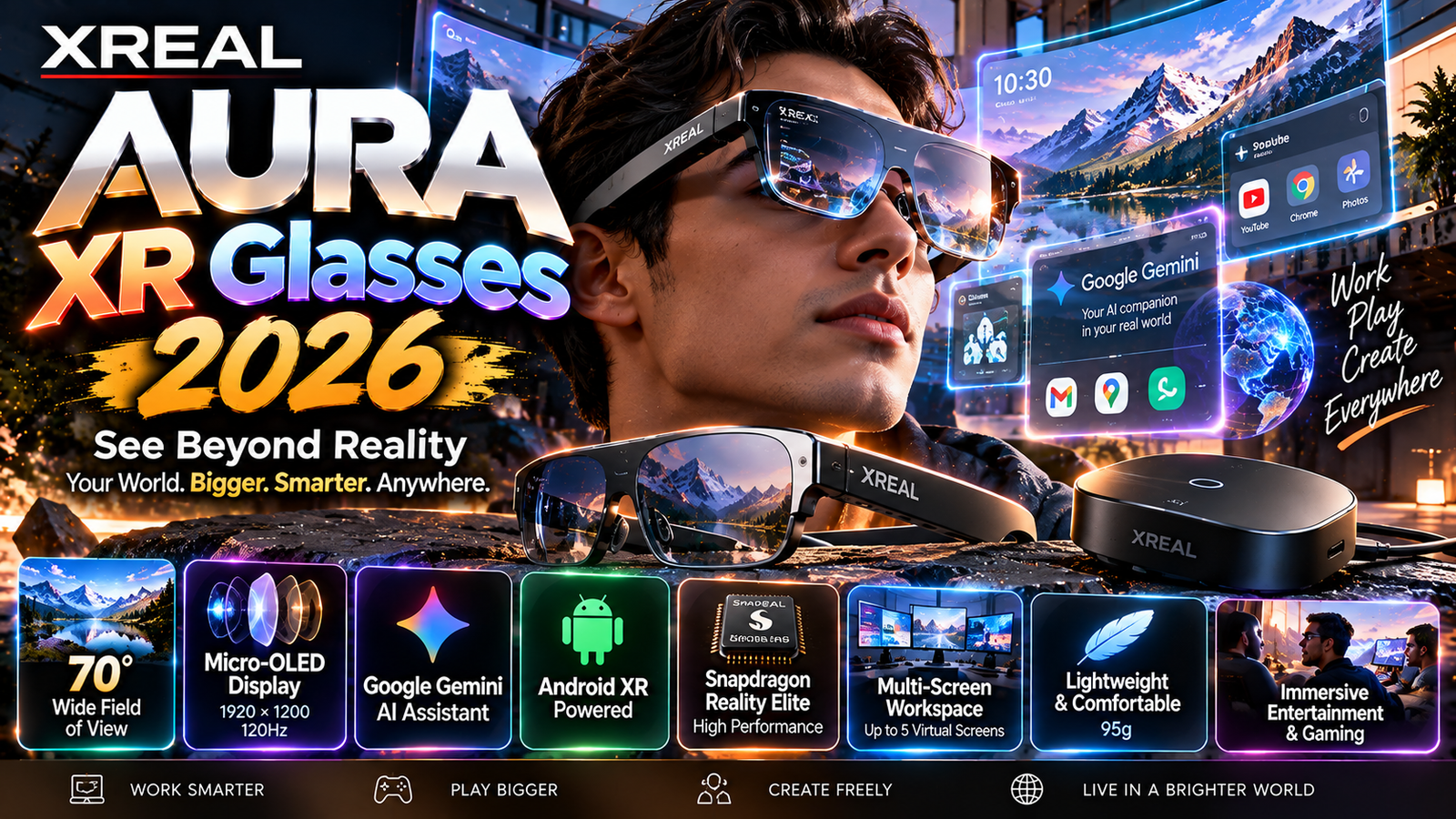
Extended reality is moving beyond bulky headsets and simple wearable screens. The latest generation of smart eyewear aims to combine familiar glasses styling with spatial displays, AI assistance, entertainment, and productivity tools. XREAL AURA XR Glasses take this approach by pairing optical see-through eyewear with a separate compute puck powered by Android XR.
Rather than placing the entire computer and battery inside the frame, the system divides the workload between the glasses and a pocket-sized unit. That design is intended to keep the eyewear lighter while providing enough processing power for immersive apps and multitasking. XREAL AURA XR Glasses are therefore better understood as a portable spatial-computing system than as ordinary display glasses.
Announced on October 28, 2026, the product brings together XREAL hardware, Google’s Android XR platform, Gemini AI, and Qualcomm’s Snapdragon Reality Elite platform. This guide explores XREAL AURA XR Glasses from a buyer’s perspective, including design, display quality, AI features, performance, entertainment, pricing, and availability.
1. Optical See-Through Design Instead of a Closed Headset
One of the biggest differences is the optical see-through design. Digital content appears in the user’s view while the real environment remains directly visible through transparent lenses. Unlike a fully enclosed virtual-reality headset, the system does not rely on a camera feed to show the room.
XREAL AURA XR Glasses use a glasses-style frame and weigh approximately 95 grams. The design includes electrochromic dimming, which offers five transparency levels and can block up to 99.9% of external light when maximum dimming is selected. This allows users to adjust how much of the outside world they see while viewing digital content.
For people who want a balance between digital experiences and real-world awareness, XREAL AURA XR Glasses offer an interesting approach. The glasses also support prescription lens inserts, with fit options designed around different interpupillary-distance ranges. Comfort remains personal: face shape, nose fit, prescription needs, and session length all matter.
2. 70-Degree Field of View and Micro-OLED Display
The visual system is a central part of the experience. The glasses use Sony Micro-OLED display panels with 1920 × 1200 resolution per eye, up to 120Hz refresh rate, 1050-nit maximum brightness, 32 pixels per degree, and a 70-degree diagonal field of view.
XREAL AURA XR Glasses are designed to place large virtual screens and spatial windows in front of the wearer. The high refresh rate can help motion appear smoother, while the Micro-OLED panels provide detailed imagery and strong contrast. XREAL lists 100% sRGB coverage and individual factory calibration with Delta E below 3.
The display specifications make XREAL AURA XR Glasses relevant to users interested in virtual monitors, movies, and immersive applications. However, a 70-degree field of view is not the same as seeing digital content across the entire human visual field. It defines the viewing area available to the display, so buyers should consider this when comparing the product with larger, fully immersive headsets.
3. Android XR and Google Gemini Integration
The software platform is one of the product’s most important features. Android XR provides access to familiar Android applications and experiences designed specifically for spatial computing. The product page describes access to Google Play apps, including YouTube, Google Maps, Chrome, and Google Photos, alongside more than 150 experiences made for XR.
XREAL AURA XR Glasses integrate Google Gemini as an assistant that can understand aspects of what the user sees and does, subject to permissions and feature availability. Users can ask questions about viewed content, seek contextual help, or interact with apps using voice and other supported inputs.
This kind of contextual assistance could be useful for learning, travel, and productivity. For example, someone watching an instructional video may ask Gemini to explain a concept without leaving the viewing experience. XREAL AURA XR Glasses could make this type of interaction feel more natural, but AI answers can be incorrect, and important information should always be independently checked.
Read more: about zarovviraf153: 9 Smart Research Methods for an Unfamiliar Digital Term
4. Split-Compute Architecture and Snapdragon Platform
Instead of putting all processing hardware into the eyewear, the system uses a separate compute puck. The puck runs on Qualcomm’s Snapdragon Reality Elite platform, while the glasses include an XREAL X1S spatial coprocessor. The company describes this as a dual-chip, split-compute architecture.
XREAL AURA XR Glasses use the X1S chip for spatial display and sensor-related processing, while the compute puck handles Android XR apps and more demanding workloads. The split is intended to balance processing performance, heat, battery capacity, and wearable comfort.
The compute puck is listed with 48 TOPS of AI processing capability. That figure describes a peak AI processing metric; it does not directly predict how fast every app or AI model will run. Real-world performance depends on software, memory, thermal limits, and workload. For buyers comparing XREAL AURA XR Glasses with other XR products, understanding this separate computing unit is essential.
5. A Portable Multi-Screen Workspace
One of the most practical possibilities is using spatial windows for work. The product supports opening up to five virtual screens and arranging them around the user’s view. A compatible PC can also be connected through USB-C DisplayPort input for wired mirroring.
For people who travel or work in compact spaces, XREAL AURA XR Glasses could provide a private workspace without carrying a large physical monitor. Users may position different windows for documents, research, messaging, and reference material.
A virtual workspace is not automatically a replacement for every desktop monitor. Long sessions, text size, visual comfort, software compatibility, and the ability to type accurately all influence productivity. XREAL AURA XR Glasses can be paired with a Bluetooth keyboard and supported input devices to make some workflows more practical.
6. Entertainment, Gaming and Spatial Media
The eyewear is also designed for watching videos, gaming, and exploring immersive content. A large virtual screen can make movies and streaming apps feel more like a private cinema, while compatible Android XR games can place interactive elements into the surrounding space.
XREAL AURA XR Glasses support access to 180-degree and 360-degree video experiences, as well as compatible spatial media. The product information also describes the ability to view photos and videos in more immersive formats, including converting supported existing media into 3D experiences.
For gaming, users can connect compatible controllers and play Android games or mirror supported handheld consoles. XREAL AURA XR Glasses may appeal to people who want a large private gaming display while travelling, but the experience depends on the game, connection method, controller support, and whether the content is designed for spatial interaction.
7. Hand Tracking, Sensors and Privacy
The glasses include two world-facing tracking cameras and support 6DoF spatial anchoring and hand tracking. Six degrees of freedom means the system can track movement through three-dimensional space, including position and orientation.
XREAL AURA XR Glasses also include a high-resolution camera with a privacy LED indicator and sensors intended to support real-time AI perception. These capabilities can help the device understand the user’s environment and support spatial interactions.
Camera and sensor features raise legitimate privacy questions. Users should understand when sensors are active, what permissions apps request, and how data is processed. The privacy indicator is useful, but it is still important to review software controls and application permissions. Anyone considering XREAL AURA XR Glasses for work should also check their organization’s policies on cameras and wearable devices.
8. Audio, Controls and Connectivity
Audio is tuned with Bose, and the glasses include a four-microphone array and spatial-audio support through Android XR. The system is intended to provide sound without requiring conventional headphones, although listening experience and sound leakage should be assessed in real-world reviews.
XREAL AURA XR Glasses support voice, hand input, and a touchpad on the compute puck. Bluetooth keyboards, mice, and game controllers are also supported. This variety gives users different ways to interact depending on whether they are watching content, gaming, or working.
Wireless connectivity includes Wi-Fi 6/6E and Bluetooth 5.3. The compute puck also includes USB-C connections, including a glasses connection and a second port for charging or DisplayPort input. Buyers should check cable compatibility and the requirements of the computer or handheld device they plan to connect.
9. Battery, Memory and Storage Options
The compute puck contains a 4455mAh rated-capacity battery, with a typical capacity listed as 4550mAh. The device is offered in two memory and storage configurations: 12GB RAM with 256GB storage, and 16GB RAM with 512GB storage. Storage uses UFS 4.0.
XREAL AURA XR Glasses rely on the compute puck for much of the system’s processing and battery capacity. Actual battery runtime will depend on display brightness, wireless activity, app workload, audio volume, and use of AI features.
The larger storage configuration may suit people who download more apps or media, while the 12GB model may be sufficient for lighter use. Buyers should compare the price difference with their expected use rather than automatically choosing the most expensive option. XREAL AURA XR Glasses are a complete system, so the compute puck’s specifications are just as important as the eyewear itself.
10. Price, Availability and Buying Advice
XREAL announced launch pricing of US$1,279 for the 12GB RAM and 256GB storage model, and US$1,499 for the 16GB RAM and 512GB model. A limited-time offer announced at launch reduces those prices to US$1,099 and US$1,299 respectively through December 2026. Shipping is expected to begin in mid-November.
Initial ordering is available in the United States, Canada, Japan, and South Korea. XREAL says additional regions will follow, with more market availability expected in 2027. Buyers in other countries should not assume that local stock, regional warranty, or support is already available.
For customers considering XREAL AURA XR Glasses in Pakistan, the final cost may include import charges, taxes, shipping, and retailer margins. Check regional compatibility, return terms, warranty coverage, prescription insert options, and whether the seller is authorized before paying.
The system is best suited to early adopters, developers, productivity users, and people interested in spatial entertainment. It may not be ideal for buyers seeking inexpensive display glasses or a fully self-contained headset with no separate compute unit.
Read more: British business chief warns against swift US trade deal
Frequently Asked Questions
What are XREAL AURA XR Glasses?
They are optical see-through spatial-computing glasses powered by Android XR, paired with a separate compute puck. They combine virtual screens, spatial apps, entertainment, and Gemini AI assistance in a wearable form.
Do they work without the compute puck?
The product uses a split-compute design. The compute puck supplies the main Android XR processing and battery, so it is an essential part of the system rather than an optional accessory.
What is the display resolution?
The Sony Micro-OLED display provides 1920 × 1200 pixels per eye, up to 120Hz refresh rate, and a 70-degree diagonal field of view.
How much do they cost?
Launch list pricing is US$1,279 for 12GB/256GB and US$1,499 for 16GB/512GB. A limited-time launch offer lowers these to US$1,099 and US$1,299 through December 2026.
Can they be used for work?
Yes. The system supports up to five virtual screens, Android XR apps, and wired mirroring from compatible computers. Comfort and workflow suitability will depend on the user’s needs and session length.
Final Verdict
XREAL’s new spatial-computing eyewear combines transparent optics, Micro-OLED displays, Android XR, Gemini assistance, and a separate Snapdragon-powered compute puck. Its strongest appeal is the ability to move between real-world awareness and digital experiences without wearing a fully enclosed headset.
XREAL AURA XR Glasses could be compelling for people who want a portable multi-screen workspace, immersive entertainment, or an early look at Android XR. However, the price is premium, the compute puck and cable are part of the experience, and international availability may be limited at first.
Before buying, compare the specifications with your actual needs, verify regional support, and consider comfort during extended use. The product represents an ambitious step in spatial computing, but its long-term value will depend on software quality, app support, battery performance, and everyday usability.
