
Introduction: Why Careful Verification Matters
Thejavasea.me leaks aio-tlp370 is a phrase that can attract attention because it combines a website reference, a leak-related claim, and a technical-looking identifier. However, the presence of a phrase online does not automatically establish that every detail connected with it is authentic.
When researching Thejavasea.me leaks aio-tlp370, readers should focus on verification rather than curiosity-driven clicking. Unknown pages, suspicious downloads, copied screenshots, and dramatic headlines can create unnecessary privacy and security risks.
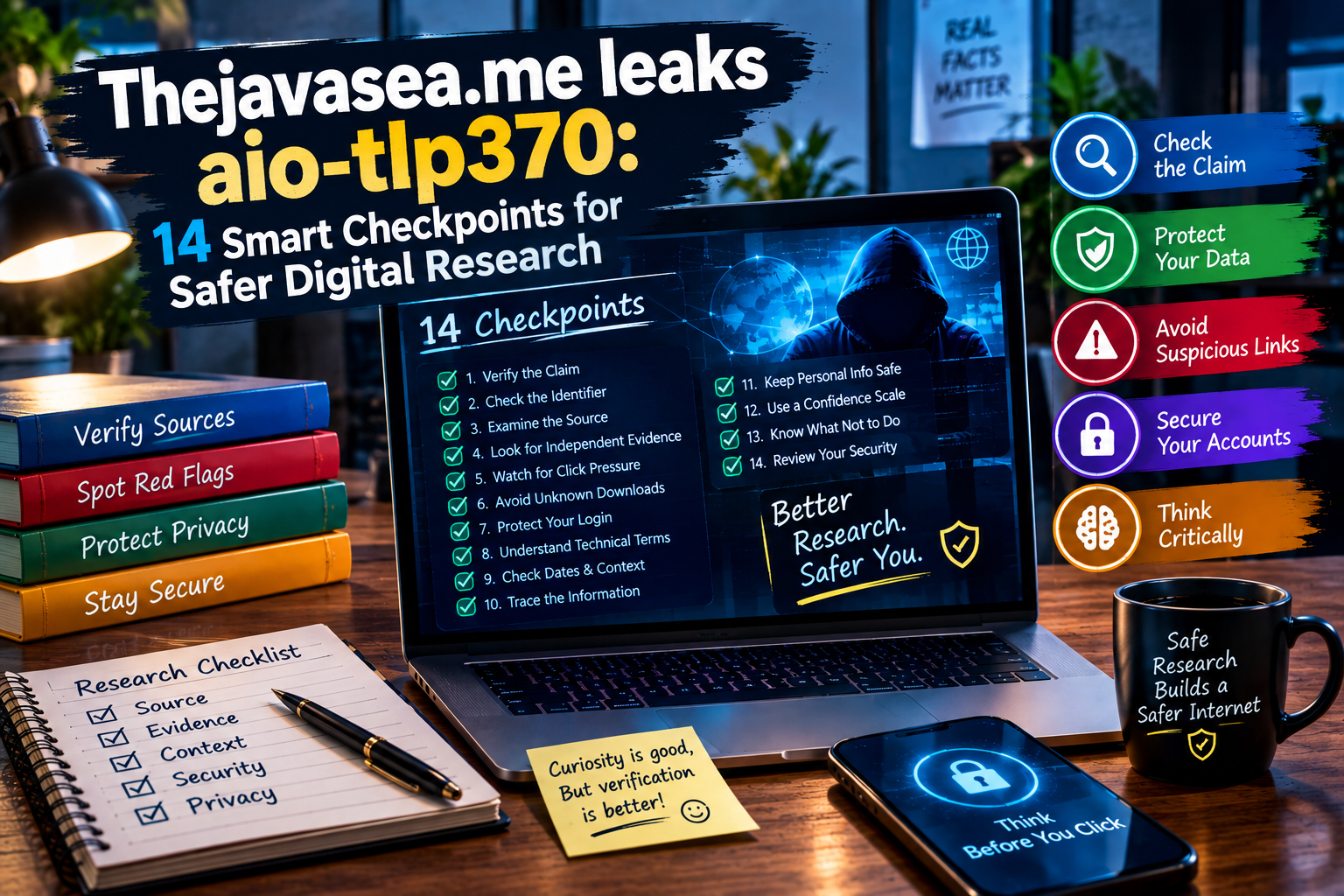
This article introduces a new 14-checkpoint framework. Instead of explaining how to locate or obtain alleged leaked material, the framework focuses on responsible digital research, source evaluation, account protection, and safer browsing habits.
Checkpoint 1: Identify What Is Actually Being Claimed
Before accepting Thejavasea.me leaks aio-tlp370 as a confirmed event, first identify the exact claim being made.
Ask:
- What supposedly happened?
- Who made the original statement?
- When was the statement published?
- Is supporting evidence available?
- Are independent sources discussing the same event?
A vague headline should not be treated like a documented fact. Separating the claim from the surrounding speculation is the first step toward better research.
Checkpoint 2: Examine the Identifier Carefully
The technical appearance of Thejavasea.me leaks aio-tlp370 may make the phrase look more authoritative than it actually is.
An identifier can represent many things, including a filename, post label, internal reference, archive name, or user-created term. Without reliable documentation, its meaning should remain uncertain.
Researchers should therefore avoid creating assumptions around individual letters, numbers, or abbreviations simply because they appear technical.
Checkpoint 3: Evaluate the Original Source
When you encounter Thejavasea.me leaks aio-tlp370, pay attention to where the information originated.
A useful source check includes:
- Identifying the publisher.
- Checking publication details.
- Looking for direct evidence.
- Checking whether the information is independently reported.
- Separating original material from reposted content.
A page that simply repeats another page does not necessarily provide additional confirmation.
Checkpoint 4: Do Not Confuse Repetition With Evidence
Search results can make Thejavasea.me leaks aio-tlp370 appear widely confirmed when several pages may actually be copying the same original claim.
Look for differences in wording, timestamps, attribution, and evidence. If ten pages repeat one sentence but all trace back to one source, the number of pages should not be mistaken for ten independent confirmations.
This is one of the most important habits for researching viral online stories.
Read more: CruzDid Com: 9 Powerful Ways to Navigate Digital Information With Confidence
Checkpoint 5: Watch for Click Pressure
Some pages connected with Thejavasea.me leaks aio-tlp370 may use urgency to encourage visitors to click immediately.
Warning signs can include:
- “Act now” messages
- Fake countdowns
- Aggressive pop-ups
- Unexpected redirects
- Repeated download buttons
- Requests for immediate sign-in
Urgency is not evidence. A trustworthy research process gives you enough time to examine the source before interacting with it.
Checkpoint 6: Treat Unknown Downloads as a Risk
If Thejavasea.me leaks aio-tlp370 appears alongside an archive or downloadable file, do not assume that opening the file will prove anything.
An unknown file may be:
- Mislabelled
- Incomplete
- Unrelated
- Manipulated
- Potentially harmful
A file cannot establish its own authenticity. Readers can often learn more by examining reliable documentation and independent reporting without downloading questionable material.
Checkpoint 7: Protect Your Login Information
Researching Thejavasea.me leaks aio-tlp370 should never require you to surrender passwords or sensitive account information to an unfamiliar website.
Be cautious if a page asks you to:
- Sign in before viewing basic information
- Enter an email password
- Provide verification codes
- Upload identity documents
- Disable browser security features
If you accidentally enter credentials on a suspicious page, use the legitimate service to change the affected password and review your account security settings.
Checkpoint 8: Understand Technical Terms Before Trusting Them
The wording in Thejavasea.me leaks aio-tlp370 contains a technical-looking “TLP” element. However, technical terminology should always be interpreted in context.
TLP can refer to the Traffic Light Protocol, a recognized framework for communicating information-sharing restrictions. That does not mean every online string containing “TLP” represents an official classification.
This distinction matters because technical vocabulary can create an impression of credibility even when its actual meaning has not been established.
Checkpoint 9: Check Dates and Context
When researching Thejavasea.me leaks aio-tlp370, always examine the date attached to the information.
Older screenshots and posts can resurface months or years later. A repost may also remove the original context, making an old statement look like a new development.
Compare:
- Original publication date
- Update date
- Screenshot date
- Event timeline
- Current reporting
Context can change the meaning of an online claim significantly.
Checkpoint 10: Trace the Information Backward
A useful research technique for Thejavasea.me leaks aio-tlp370 is to move backward from the newest post toward the earliest credible source.
Instead of asking, “How many websites mention this?”, ask:
“Where did this information begin?”
This helps identify copied articles, recycled screenshots, anonymous claims, and posts that add dramatic language without adding evidence.
Source tracing is about improving confidence, not collecting more copies of the same claim.
Checkpoint 11: Keep Personal Information Out of the Investigation
If Thejavasea.me leaks aio-tlp370 is discussed alongside names, email addresses, credentials, documents, or other personal information, avoid copying or redistributing those details.
Even when information is publicly visible, sharing it again can increase privacy harm.
A responsible research article can discuss:
- The claim
- The available context
- Verification methods
- Security concerns
- Privacy considerations
There is rarely a good reason to reproduce sensitive personal information merely to demonstrate that it exists.
Checkpoint 12: Use a Confidence Scale
For Thejavasea.me leaks aio-tlp370, a simple confidence scale can make research easier.
Level 1 — Online Mention
A phrase appears in a post or search result without meaningful supporting evidence.
Level 2 — Attributed Claim
A source makes a specific allegation, but independent confirmation is limited.
Level 3 — Corroborated Information
Multiple credible and independent sources provide consistent supporting context.
Level 4 — Documented Fact
Reliable primary or official documentation establishes the relevant details.
The important rule is simple: repeated claims should not automatically move information from Level 1 to Level 4.
Checkpoint 13: Know What Not to Do
When dealing with Thejavasea.me leaks aio-tlp370, avoiding risky behavior can be just as important as finding information.
Do not:
- Download suspicious archives.
- Enter passwords into unfamiliar pages.
- Disable security protections because a page requests it.
- Repost private information.
- Treat screenshots as complete evidence.
- Assume technical terminology proves authenticity.
- Share unverified claims as established facts.
Responsible research is not about accessing everything available online. It is about understanding information while reducing unnecessary exposure.
Checkpoint 14: Finish With a Security Review
After researching Thejavasea.me leaks aio-tlp370, take a moment to review your own digital activity.
Ask:
- Did I visit an unfamiliar website?
- Did I download anything unexpected?
- Did I enter account information?
- Did I click a suspicious redirect?
- Did I share any sensitive material?
If the answer to all of these is no, normal security habits may be sufficient.
If credentials were entered into an untrusted page, change them through the legitimate service. If an unexpected file was downloaded, avoid opening it and use appropriate security software or professional assistance when needed.
Read more: Stock market crash? No, British shares are 15pc undervalued
The Four-Step Research Loop
The 14 checkpoints above can be simplified into a four-step process for future claims.
1. Check
Start with the source, date, wording, and evidence.
2. Question
Challenge technical labels, screenshots, dramatic claims, and repeated statements.
3. Protect
Keep accounts, passwords, devices, and personal information away from unnecessary risks.
4. Confirm
Look for independent and credible evidence before treating an unusual online claim as established.
This process works not only for Thejavasea.me leaks aio-tlp370, but also for unfamiliar breach reports, questionable archives, suspicious security posts, and viral technical stories.
Why Search Results Can Be Misleading
Search visibility does not equal authenticity.
A phrase such as Thejavasea.me leaks aio-tlp370 can appear on multiple websites because content is frequently copied, summarized, syndicated, or discussed by other users.
Therefore, the number of search results is not a reliable measurement of credibility.
Instead, examine the quality of the sources. A smaller number of strong sources can provide more useful context than hundreds of pages repeating an unsupported statement.
The Screenshot Problem
Screenshots connected to Thejavasea.me leaks aio-tlp370 should also be treated carefully.
A screenshot can be cropped, edited, taken out of context, or presented without its original publication details. It may show what appeared on a screen, but it does not automatically establish when, where, or why that content appeared.
Whenever possible, look for the original source and surrounding context rather than relying only on an isolated image.
The Difference Between Curiosity and Verification
Internet users often approach unusual topics because they want to know what happened. Curiosity itself is not a problem.
The risk begins when curiosity turns into automatic clicking.
For Thejavasea.me leaks aio-tlp370, verification should come before exposure. You do not need to interact with questionable files or suspicious websites merely to decide whether a claim deserves attention.
A safer researcher asks questions first and clicks later, if interaction is necessary at all.
A Practical Checklist for Readers
Before trusting information about Thejavasea.me leaks aio-tlp370, run through this quick checklist:
Source
Is the publisher identifiable?
Date
Is the information current and properly dated?
Evidence
Is there something verifiable behind the claim?
Independence
Are other sources providing genuinely independent confirmation?
Security
Could clicking or downloading create unnecessary risk?
Privacy
Does the information expose someone else’s sensitive details?
Context
Has the original information been presented completely?
Confidence
Is the claim being described as uncertain when evidence is limited?
This checklist can be completed quickly and can prevent many common online research mistakes.
Common Misunderstandings
One misunderstanding is that a technical identifier must have an official meaning. That is not necessarily true.
Another is that repeated posts represent independent evidence. They may simply originate from the same source.
A third misunderstanding is that downloading an alleged leak provides stronger verification. In reality, an unknown file can introduce additional security concerns without proving its contents.
Finally, people sometimes assume that publicly accessible information can always be freely redistributed. Privacy and responsible disclosure considerations can still apply.
Final Perspective
Thejavasea.me leaks aio-tlp370 is best approached through careful source evaluation rather than assumptions. The exact meaning, authenticity, and surrounding claims should not be accepted simply because a phrase appears repeatedly online.
The strongest research habits are straightforward: inspect the source, check dates, question technical terminology, avoid suspicious downloads, protect account credentials, respect privacy, and look for independent confirmation.
When information remains uncertain, saying “unverified” is more responsible than filling the gaps with speculation. Good digital research is not measured by how much questionable material someone can access. It is measured by how accurately they can understand a claim while keeping themselves and others safer.
For anyone researching Thejavasea.me leaks aio-tlp370, the 14-checkpoint approach provides a practical path: identify the claim, evaluate the source, protect your digital environment, and confirm important details before treating them as established information.
